





















By: Fern Sidman
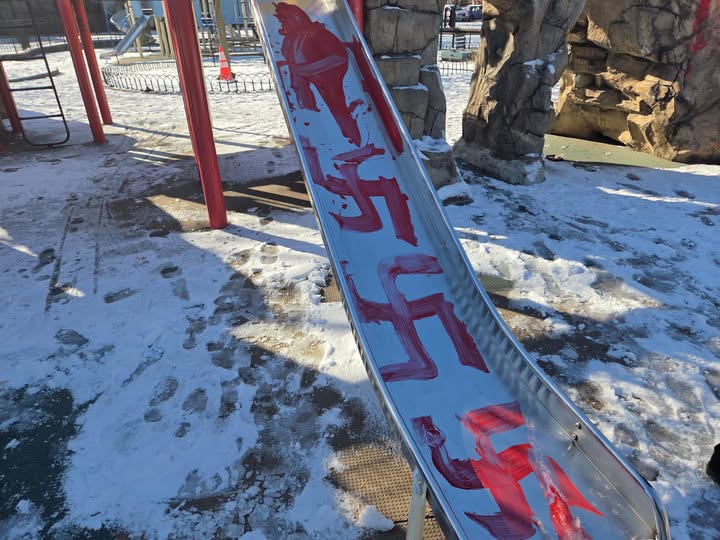
Residents of Brooklyn’s Boro Park awoke this week to a sight so jarring, so grotesquely out of place, that it sent a shudder through one of New York City’s most tightly knit Jewish communities. In a playground designed for laughter, innocence, and the everyday rituals of childhood, large red swastikas were discovered spray-painted across a slide and the surrounding pavement at Gravesend Park—an act of vandalism that authorities are now investigating as a hate crime.
According to a detailed report and on-the-ground updates from JFeed.com, the discovery was made on Wednesday morning, after recent snowfall and frigid temperatures had left the park largely deserted. Investigators believe the perpetrators exploited the cold and the absence of foot traffic to carry out the act undetected, leaving behind vivid symbols of genocidal hatred in a space meant for children.
Boro Park is not merely another Brooklyn neighborhood. It is one of the largest Orthodox Jewish enclaves in the United States, home to tens of thousands of observant Jews, many of them descendants of Holocaust survivors who rebuilt their lives in New York after fleeing the ashes of Europe. As JFeed.com has emphasized in its coverage, the symbolism of swastikas—rendered in bright red, evocative of blood—strikes at the very core of communal memory and identity.
The vandalism was discovered on playground equipment frequented daily by young children, a detail that has intensified the sense of outrage and unease. Parents arriving with strollers, children bundled against the cold, were confronted not with swings and slides but with emblems synonymous with mass murder and historical trauma.
Within hours of the discovery, members of the Boro Park Shomrim patrol organization arrived at the scene, coordinating with officers from the New York Police Department, who promptly launched a hate crime investigation. Police cordoned off portions of the playground as forensic teams documented the graffiti and canvassed the area for surveillance footage.
Brooklyn Community Board 12 issued an unusually blunt statement condemning the act, reflecting the depth of communal anger and alarm. “These sick individuals need to discover that actions have consequences,” the board declared, according to the report at JFeed.com. “We hope justice will be served quickly.”
The Anti-Defamation League also weighed in, expressing particular horror that a space intended for children had been defiled. “Parents should never have to fear that their children will encounter vile hate at a playground,” the ADL stated. “We are revolted to see this display of antisemitism in Boro Park, home to tens of thousands of Jewish New Yorkers and thousands of Holocaust survivors.”
As the JFeed.com report noted, the language of the ADL’s response underscored not only the offensiveness of the act but its psychological violence: the deliberate intrusion of hatred into a space associated with safety, joy, and communal trust.
City sanitation crews were dispatched to remove the graffiti as quickly as possible, a priority emphasized by local leaders eager to minimize the exposure of children to the imagery. Yet even as the paint was scrubbed away, the emotional residue lingered.
One of the most resonant reactions came from Yakov Berman, a prominent Chabad community activist, who took to X (formerly Twitter) to articulate what many in the community were feeling but struggling to name. His words drew a chilling parallel between the present moment and the warnings of Jewish history.
Berman recounted that just hours before seeing the photographs of the vandalism, he had attended a Jewish cultural event in New York City whose location had been kept secret until the last possible moment due to security concerns. The event featured a play about Ze’ev Jabotinsky, the founder of Brit Trumpeldor (the Betar Zionist youth movement) who famously warned European Jewry in the 1930s that the storm clouds of catastrophe were gathering—and that complacency would prove fatal.
“When I returned home tonight, I saw these photos taken today… in the heart of Boro Park,” Berman wrote, according to the JFeed.com report. “I found myself asking: Are we really living in a time where Jewish cultural events need to be kept secret to protect attendees? Swastikas in parks? Are we ignoring the signs?”
The comparison was not made lightly. For many, the juxtaposition of a Jabotinsky-themed event and Nazi symbols in a Brooklyn playground felt less like coincidence and more like an unsettling historical rhyme.
The Boro Park incident does not exist in isolation. As JFeed.com has repeatedly documented, antisemitic incidents across New York City—and across the United States—have surged dramatically in recent years. Graffiti, harassment, assaults, and threats have increasingly targeted visibly Jewish neighborhoods, institutions, and individuals.
What distinguishes the Boro Park vandalism, however, is its location and its intended audience. Hate graffiti on a synagogue wall or a storefront, while deeply disturbing, follows a grimly familiar pattern. Swastikas on playground equipment cross a different threshold: they are aimed not only at a community but at its children.
Experts on hate crimes note that such acts often serve multiple purposes—intimidation, provocation, and symbolic domination. By placing Nazi symbols in a children’s playground, the perpetrators send a message that no space is off-limits, that even the most innocent corners of communal life can be violated.
As JFeed.com observed in its analysis, this tactic mirrors historical patterns in which antisemitism escalates from rhetoric to symbolic violence before manifesting in more direct physical harm.
The NYPD has confirmed that the incident is being treated as a hate crime, a classification that carries enhanced investigative resources and potential penalties. Detectives are reviewing nearby security cameras, including those from adjacent streets and residential buildings, to identify suspects. Community members have been urged to come forward with any information, no matter how minor it may seem.
Boro Park Shomrim, meanwhile, has increased patrols in the area, particularly around schools, synagogues, and playgrounds. According to the information provided in the JFeed.com report, volunteers have also been engaging with parents and educators to provide reassurance and practical safety guidance.
Yet even as law enforcement mobilizes, community leaders stress that the deeper challenge is cultural as much as criminal. Removing graffiti addresses the symptom, not the disease.
For many residents of Boro Park, the vandalism has prompted painful conversations at kitchen tables and in classrooms. How does one explain a swastika to a five-year-old? How does one balance the imperative to protect children’s innocence with the reality that hatred exists—and sometimes announces itself in the most brutal ways?
As the JFeed.com report poignantly noted, the presence of Holocaust survivors in the neighborhood lends an additional layer of gravity. For those who lived through the original terror symbolized by the swastika, seeing it reappear—sprayed casually onto playground equipment—can reopen wounds that never fully healed.
At the same time, there is resolve. Community leaders, activists, and ordinary residents alike have emphasized that Boro Park will not be intimidated. Public statements, increased vigilance, and a renewed commitment to education and remembrance have followed the incident.
Yakov Berman’s invocation of Jabotinsky’s warnings has resonated precisely because it touches a nerve that runs deep in Jewish historical consciousness. The question he posed—“Are we ignoring the signs?”—is not easily dismissed.
Yet there is another lesson embedded in Jewish history: resilience, solidarity, and the refusal to retreat from public life. As the JFeed.com report highlighted in its coverage, the response to the vandalism has included not only condemnation but affirmation—of Jewish presence, of communal pride, and of the right to safety and dignity in every corner of the city.
The swastikas were an attempt to inject fear into a community. Instead, they have exposed a broader truth: that vigilance remains necessary, but so does the courage to confront hatred openly and collectively.
As investigators continue their work and the paint fades from the playground, the deeper imprint of the incident endures—a stark reminder that the fight against antisemitism is not a relic of the past, but an urgent challenge of the present.