













By: Fern Sidman
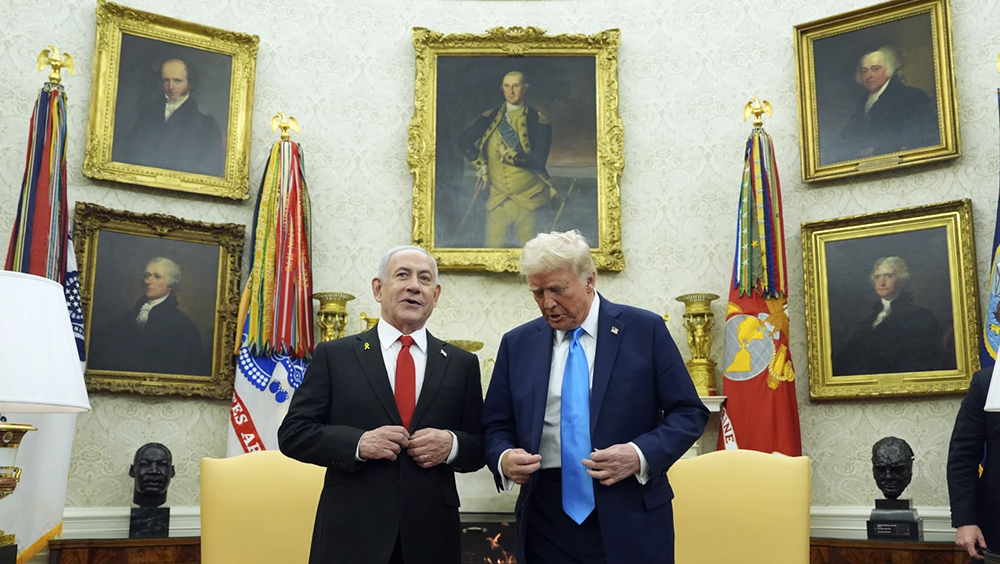
In a sharp and unequivocal statement issued Friday, the Prime Minister’s Office (PMO) in Jerusalem dismissed as “categorically false” a report published by Israel Hayom alleging that Prime Minister Benjamin Netanyahu had engaged in a high-level diplomatic conversation with President Donald Trump, Secretary of State Marco Rubio, and Israeli Strategic Affairs Minister Ron Dermer regarding the establishment of a Palestinian state.
Israel did NOT agree to a Palestinian state, Netanyahu’s office insists.
The daily newspaper Israel Hayom reported that following the Iran war, US President Donald Trump presented a comprehensive regional deal including the establishment of a Palestinian state, and that Prime… pic.twitter.com/KNJ9aujUFh
— Sarah Malcangi (@MalcangiSarah) June 27, 2025
According to a report at the Jewish News Syndicate (JNS), the denial comes amid heightened speculation in the Israeli press about the future of Gaza governance and the potential revival of regional peace talks in the aftermath of U.S. and Israeli strikes on Iran. The alleged phone call was said to have taken place shortly after “Operation Midnight Hammer,” the American-led airstrike campaign targeting Iran’s nuclear infrastructure on June 22. The Israel Hayom article cited unnamed sources who described the tone of the conversation as “euphoric” following the successful coordination of military operations between Washington and Jerusalem.
However, the Prime Minister’s Office was adamant: “The conversation described in the article did not take place. Israel was not presented with the political proposal supposedly described in the article, and it obviously did not agree to it.” The PMO’s statement, carried by JNS and other Israeli outlets, rejected the idea that Jerusalem had received or endorsed any American plan involving a two-state solution or a post-Hamas governance model for Gaza.
According to the disputed report, Trump and his counterparts discussed a sweeping regional framework that included several ambitious goals: the expansion of the Abraham Accords to additional Arab nations, an expedited end to the war in Gaza within two weeks, a multi-national Arab-led authority to administer Gaza in Hamas’s absence, and a conditional Israeli endorsement of a demilitarized Palestinian state. The article also asserted that the plan envisioned the exile of Hamas leadership, international resettlement options for certain Gaza residents, and limited U.S. recognition of Israeli sovereignty in portions of Judea and Samaria.
The Jewish News Syndicate reported that senior diplomatic figures in both Washington and Jerusalem have remained largely silent on the alleged proposal. Nonetheless, rumors of intense behind-the-scenes coordination between the two governments have proliferated since the coordinated U.S.-Israel strikes on Iranian nuclear facilities, which many observers view as a turning point in the regional balance of power.
The same Israel Hayom article went further, claiming that Trump—reportedly angered by Israel’s continued air operations in Iran after his ceasefire announcement—pressured Netanyahu to conclude military actions swiftly and shift toward a political solution in Gaza. The PMO has firmly rejected this portrayal, stating no such pressure was applied and that operational decisions remain sovereign to the Israeli security establishment.
The JNS report noted that this incident comes at a politically sensitive time for Netanyahu, who is navigating a complex landscape of domestic challenges, a volatile security situation on multiple fronts, and renewed interest from international partners in brokering a comprehensive resolution to the Gaza conflict.
While the PMO continues to deny the existence of any binding agreement or formal proposal involving a two-state solution, Netanyahu has not ruled out future diplomatic breakthroughs. On Thursday night, he posted on X (formerly Twitter) that Israel’s successful deterrence against Iran “has created an opportunity for a dramatic expansion of the peace agreements”—a clear reference to broadening the Abraham Accords framework with additional Arab nations, especially in the Gulf.
JNS reported that while Netanyahu has historically resisted international pressure to accept a Palestinian state, his administration may now find itself at a diplomatic crossroads. The convergence of geopolitical realignments—accelerated by joint Israeli-American military operations—has opened new possibilities for strategic recalibration across the region.
Still, key analysts cited by JNS caution that no shift should be expected without ironclad guarantees. “Netanyahu will not endorse any Palestinian entity that jeopardizes Israeli security,” said a former Israeli national security advisor. “What we may see is a series of diplomatic ‘understandings’ rather than a final status agreement.”
The Prime Minister’s firm denial appears aimed at reassuring his base and coalition partners who remain vehemently opposed to a two-state framework. Domestic political stability is also a factor. With judicial reforms, the ongoing conflict with Hezbollah in the north, and continued skirmishes in Gaza, the Prime Minister is unlikely to wade into the politically hazardous waters of renewed final-status negotiations.
According to the JNS report, the broader message from Jerusalem remains one of vigilance and sovereignty. While Netanyahu acknowledges the need for post-war planning in Gaza, the official line is that this will not include the reinstallation of the Palestinian Authority, nor any entity affiliated with Hamas or Iran.
As the dust settles from Operation Midnight Hammer and its regional ramifications continue to unfold, the gap between diplomatic speculation and formal policy remains wide.
For now, Jerusalem’s message is clear: No conversation occurred, no agreement was reached, and no Palestinian state is on the table. Whether that position endures in the face of shifting regional alliances and American influence remains an open—and explosive—question.