
















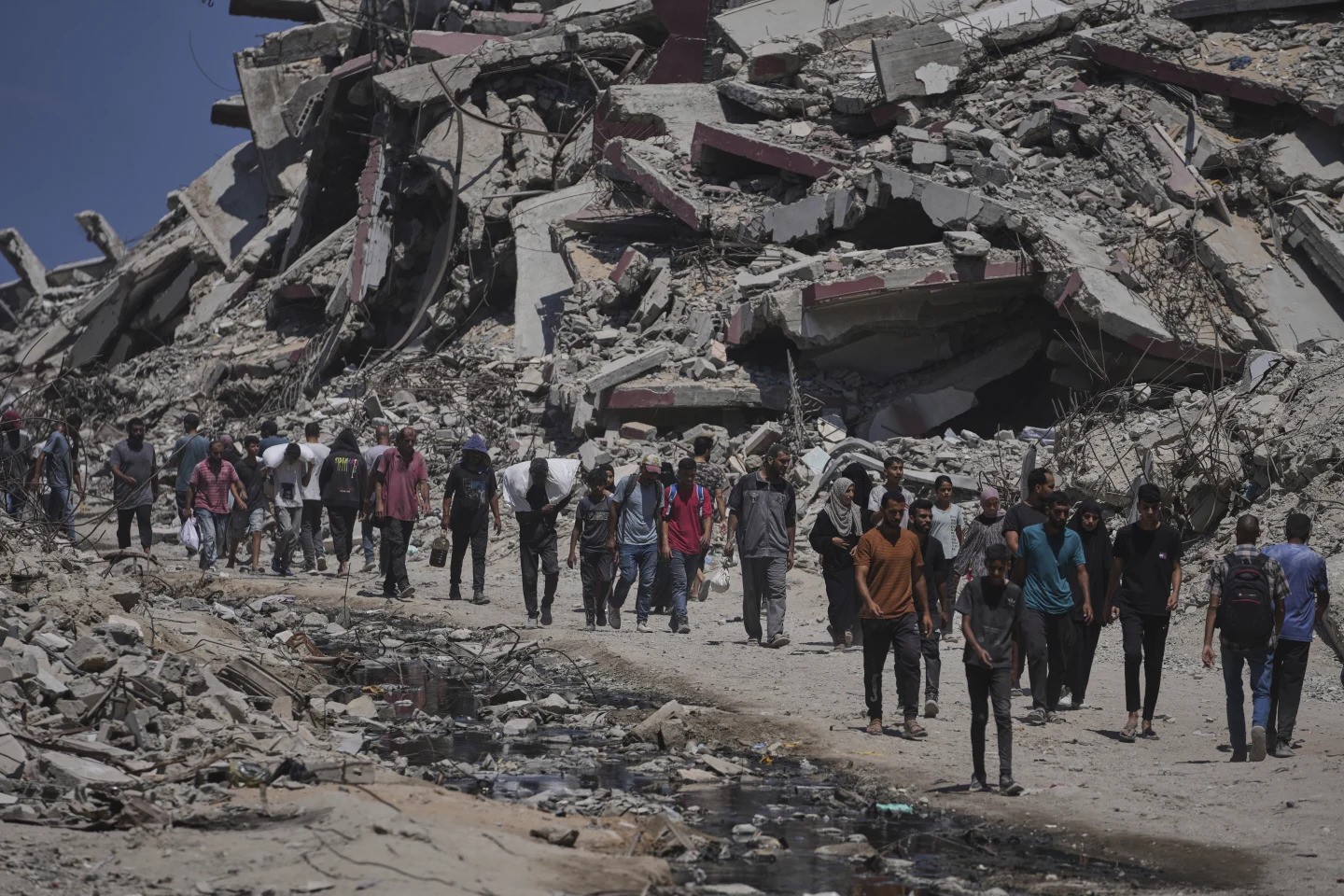
By: Fern Sidman
As allegations continue to surface in global media portraying Israel as an indiscriminate aggressor in the Gaza Strip, the Israel Defense Forces (IDF) took the unusual step of releasing firsthand footage that sheds critical light on the reality unfolding along the volatile Gaza border. According to the IDF’s Arabic-language spokesperson, the narrative being pushed by certain international outlets—chief among them the Associated Press—is a distortion that conveniently serves the propaganda machinery of Hamas.
🚨PLEASE SHARE WIDELY🚨
Wild Footage: Masses of Gazan Civilians Just Meters from IDF Soldiers – The Order: “No One Fires!”
Amid claims that the IDF fired at civilians in the jihadist occupied Gaza strip, in areas where humanitarian aid is distributed, the IDF Arabic-language… pic.twitter.com/fegp3s2Wdg
— Cheryl E 🇮🇱🎗️ (@CherylWroteIt) July 20, 2025
In a video released Sunday night, the IDF provided visual evidence of an incident that occurred earlier that day near the humanitarian aid corridors into Gaza. The footage shows hundreds of Gazan civilians swarming a humanitarian aid truck—an aid convoy authorized by Israel as part of ongoing efforts to mitigate suffering in the Hamas-controlled enclave. As the scene unfolded, Israeli soldiers, stationed mere meters away and on high alert, maintained strict fire discipline. “No one opens fire!” one soldier is heard ordering in Hebrew, a direct command issued amid a volatile situation where the risk of chaos escalating into violence was palpable.
The footage, widely distributed by the IDF’s Arabic-language spokesperson, underscores a point the Israeli military has reiterated consistently throughout this conflict: contrary to allegations from Hamas-affiliated sources and sympathetic international organizations, the IDF is neither targeting civilians nor obstructing the flow of humanitarian aid. Rather, as the IDF stated, “There is no famine, no deliberate killing, and no intentional harm to those seeking aid. There is only Hamas propaganda, with media outlets spreading lies to salvage what’s left of the defeated Hamas.”
The Associated Press, however, presented a starkly different version of events. On Sunday, the AP reported that Gaza “saw its deadliest day yet for aid-seekers in over 21 months of war,” quoting the Hamas-run Gaza Health Ministry as claiming at least 85 Palestinians were killed while attempting to reach food supplies. According to the AP, the highest casualty count occurred in northern Gaza, where the Health Ministry alleged that 79 Palestinians died at the Zikim crossing—a zone through which Israeli-authorized aid convoys are permitted to enter.
The AP further quoted a U.N. official, speaking anonymously, who accused Israeli forces of opening fire on the crowds gathered around the aid trucks. The Associated Press claimed that video footage captured by the U.N. showed Palestinian men running amidst the sound of automatic gunfire.
The IDF’s response, notably direct and unequivocal, highlights what many observers see as a deliberate manipulation of facts by Hamas-controlled entities and their international media enablers. The footage released by the IDF reveals not an army bent on killing, but soldiers exercising remarkable restraint under tense and unpredictable conditions.
For Israel, the implications extend far beyond a single incident. As the IDF’s Arabic spokesperson emphasized, these accusations serve Hamas’s strategic interest—fueling international outrage, undermining Israel’s moral standing, and shifting global attention away from Hamas’s use of human shields, its diversion of humanitarian aid, and its ongoing terrorist activities. The broader context, one the IDF has repeatedly highlighted, is that Hamas bears ultimate responsibility for the humanitarian crisis in Gaza, having embedded itself within civilian populations and systematically obstructing aid deliveries to maintain its grip on power.
Israel’s military campaign, conducted in the wake of Hamas’s October 7 massacre of 1,200 Israelis and the abduction of 251 others, has been accompanied by a concerted effort to facilitate humanitarian aid flows into Gaza, despite ongoing hostilities. Yet, as the IDF video illustrates, these efforts are consistently undermined by the chaotic conditions on the ground—conditions Hamas actively exploits.
Moreover, the allegations published by the Associated Press mirror a troubling pattern noted by Israeli officials and military analysts alike: reliance on reports originating from the Hamas-controlled Gaza Health Ministry, an entity with a vested interest in portraying Israel in the worst possible light. The New York Times and other media outlets have previously documented similar instances where Hamas’s narrative, disseminated via international agencies, bore little resemblance to verified facts on the ground.
The humanitarian corridors opened by Israel have been repeatedly co-opted by violent elements within Gaza, turning aid deliveries into flashpoints of unrest. The IDF has cited numerous cases where Hamas operatives have seized aid meant for civilians or used aid convoys as cover for military activity. Against this backdrop, Israel’s insistence on carefully controlled, coordinated humanitarian access reflects a balancing act between military necessity and humanitarian responsibility—a reality often omitted in media reports such as those of the Associated Press.
Additionally, the Associated Press report on Israel’s military issuing evacuation orders for central Gaza conveniently glosses over the security rationale for such measures. These directives, as Israeli officials have explained, are aimed at preempting Hamas’s attempts to regroup in areas where the IDF has thus far maintained a limited operational presence. The notion that these orders constitute a targeted campaign against civilians is yet another distortion the IDF firmly rejects.
The IDF’s response to Sunday’s incident at the Zikim crossing, combined with its transparent release of real-time footage, offers a stark counter-narrative to the image of a rogue military force depicted in some international media. Instead, what emerges is a portrait of soldiers tasked with the unenviable duty of maintaining border security under the constant threat of Hamas attacks—soldiers who, despite provocation, act with commendable restraint.
As the IDF Arabic spokesperson succinctly stated, “There is no famine. There is no massacre. There is only Hamas propaganda.” This assertion echoes Israel’s broader diplomatic stance that Hamas’s information warfare is as much a part of its arsenal as its rockets and terror tunnels.
The Associated Press’s reliance on anonymous sources and Hamas-controlled data raises serious questions about the credibility of its reporting. Time and again, as events in this conflict have shown, initial narratives built on Hamas’s version of events have later unraveled under factual scrutiny. Israel’s policy of documenting its military engagements—sometimes at risk to its operational security—serves not only its immediate security needs but also the imperative of defending its reputation against a tide of misinformation.
For Israel and its supporters, the events of Sunday serve as a stark reminder of the dual front it faces: a physical battle against Hamas’s terrorism and a parallel fight against a relentless propaganda campaign designed to erode international support for Israel’s legitimate right to self-defense.
The IDF’s public release of footage depicting disciplined soldiers refraining from opening fire, even when confronted by an unruly crowd, stands in stark contrast to the narratives peddled by outlets such as the Associated Press. The images captured—Israeli soldiers exercising human restraint amidst the fog of war—tell a story far removed from the accusations of wanton brutality.
In a conflict as complex and morally fraught as the one in Gaza, context matters. And as the IDF’s release demonstrates, the truth often lies in the details that certain media reports prefer to omit.